 Contact Us
How much bajri does your dream house really need? Here is a number that surprises most home builders. A 5 Marla plot is approximately 1,125 sq. ft. However, a double-storey 5 Marla house can have approximately 1,975 sq. ft. of covered area. This is the total floor area constructed, and this is what your concrete follows.
House Size | Plot Area | Approximate Covered Area (if double storey) |
5 Marla | 1,125 sq ft | 1,975 sq ft |
10 Marla | 2,250 sq ft | 3,300 sq ft |
1 Kanal | 4,500 sq ft | 5,950 sq ft |
And why is this important? If you estimate your bajri based on your plot size, you will either have insufficient amounts or excessive amounts of this material. In the case of the former, you won’t be able to finish the pouring of the roof slab. In the latter case, you’ll have bajri lying on the roadside, mixed with dust and wasted. Bajri estimation at the beginning stage can help you in planning deliveries and budgeting.
Plot size informs you about the land. Covered area tells you how many floors you will construct on the given land. But the exact quantity of bajri will depend not only on these factors, but also on:
Your structural drawings
Your foundation plans and soil conditions
The number of floors
The concrete ratio chosen by your engineer
What Is Bajri, and Where Is It Used in House Construction?
Bajri is the crushed stone that gives concrete its strength. It is the biggest single ingredient in the concrete of your foundations, columns, beams, and roof slab. If the bajri is wrong, the whole frame suffers.
These words often get used for the same thing on site. They are not quite the same. Here is how they are commonly understood:
Term | What it usually means | Common use |
Bajri/Crush | Crushed stone used in concrete | Slabs, beams, columns, foundations |
Gravel | Rounded stone, often from rivers | Some concrete and base work |
Rori | Bigger, rough stone or brick pieces | Base layers under floors |
Bajri/Crush in reinforced cement concrete (RCC)
The surfaces of crushed stones have sharp edges. The cement paste firmly bonds these sharp edges. Smoothed-out stones lack such firm bonding power.
In addition, stones occupy more volume in concrete than anything else. Consider a typical 1:2:4 mix; 4 portions out of every 7 portions consist of the aggregates. This implies that the stones bear most of the load, and thus there is a need for a smaller amount of cement to fill the voids. The steel rods resist tensile stresses, while the concrete with stone structure resists compressive stresses.
Bajri/Crush in foundations, columns, beams, and roof slabs
Every concrete part of your house frame contains bajri. Think of the house as a chain. Each link passes the weight down to the next.
Roof slab. The flat concrete roof, often called the lintel. It is usually the biggest single pour.
Beams. They carry the slab and pass its weight to the columns.
Columns. They carry the beams and pass the weight down to the foundation.
Foundations. They spread the whole load into the soil.
Is the same crush size suitable for every construction application?
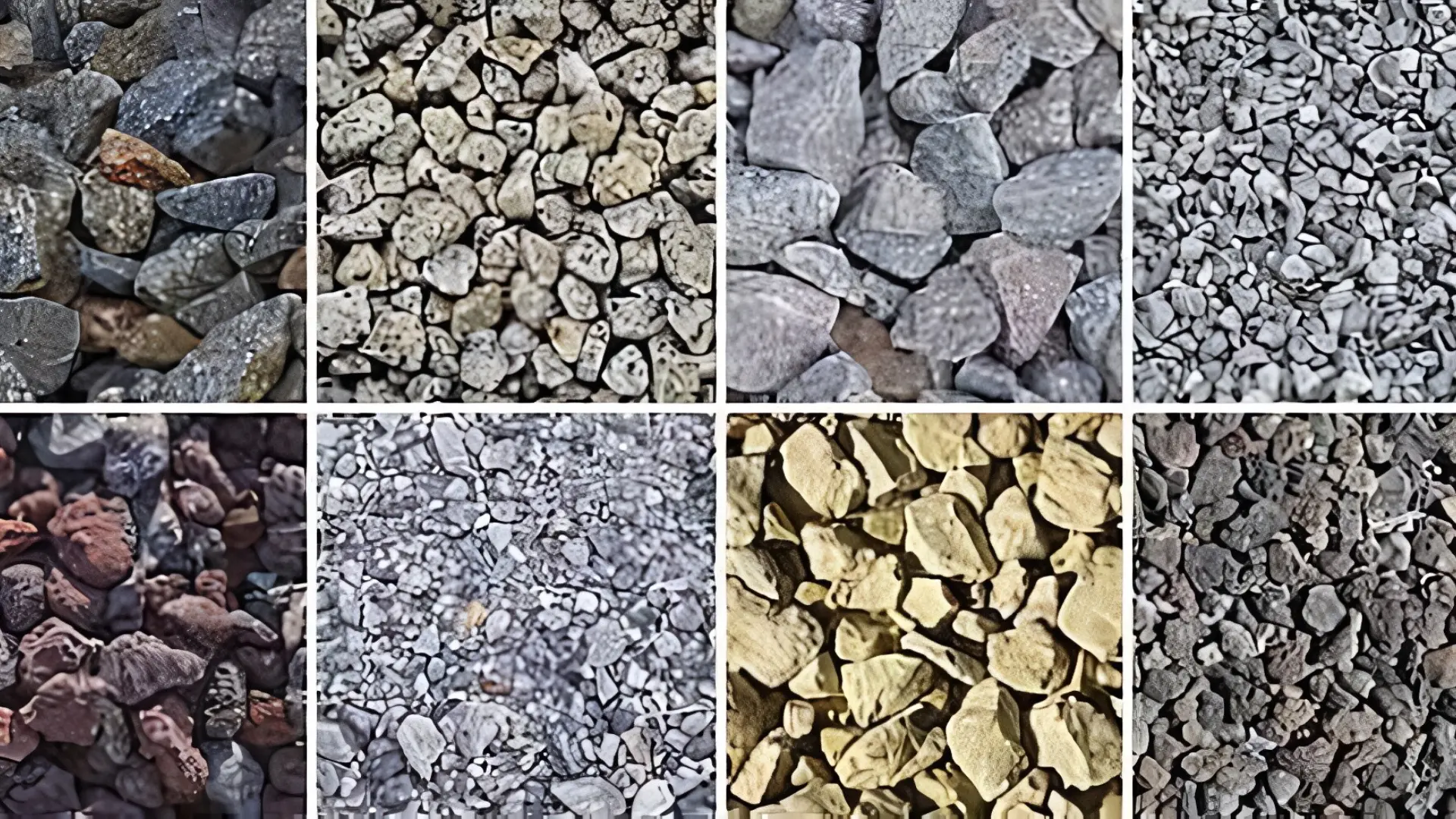
No. Stone size has to suit the job. A thin slab packed with steel bars needs smaller stone that can flow between the bars. A large foundation has more room.
GharHub's crush rate page gives this general guide:
40mm crush: typically for foundations and mass concrete
20mm crush: for structural parts such as slabs and columns
Margalla 20mm: described as preferred for high-strength concrete
Dina Bajjar crush: suitability depends on its gradation, so check size against use
Weight flows down the frame: roof slab to beams, beams to columns, columns to foundations, foundations into the soil. Every shaded part is concrete that needs bajri.
What Factors Affect Bajri Requirements for a House?
Now you know where bajri goes. The next question is why two houses on the same plot size can need very different amounts. These factors make the difference.
Plot size versus actual covered area: Plot size is the land you own. Covered area is the floor you build, added up across every storey. Concrete follows covered area, not land.
Single storey versus double storey construction: A second storey adds a whole new roof slab, more beams and more columns. Your foundations also get bigger to carry the extra weight.
Foundation depth and soil conditions: Weak or soft soil needs wider or deeper foundations. Some sites need a raft, which is one thick slab under the whole house. A raft can use far more concrete than separate footings.
Roof slab thickness, beam dimensions, and column sizes: Small changes in size add up quickly. Just one extra inch adds about 83 cubic feet of concrete. Bigger beams and columns add more again.
Concrete mix design and structural specifications: The mix tells you how much of each ingredient goes into the concrete. A 1:2:4 mix and a 1:1.5:3 mix use different amounts of stone for the same volume.
Material wastage, handling losses, and delivery quantities: Some bajri is always lost. It spills during unloading, sinks into mud, or gets left in the mixer.
Bajri Estimate for a 5 Marla House in Pakistan
A 5 Marla house is the most common family home in many Pakistani cities. It is also where small estimate errors hurt the most, because the budget is usually tight. Let us apply the factors above to this size.
Total Crush Requirement For Covered Area
More covered area means more slab, more beams, and more columns. For example, the house covers 1,975 square feet. That is made up of about 910 and 890 square feet on the two main floors, plus a 175 square foot mumtee.
Use | Quantity |
Roof slab (lenter) | about 900 cubic feet |
Floors | about 600 cubic feet |
Total | about 1,500 cubic feet |
How to calculate the cost of bajri using a verified unit rate
Once you have a quantity, cost is simple. Multiply the quantity by the price per cubic foot. Here is an example with GharHub's listed rates:
Part | Quantity | GharHub product | Listed rate | Material cost |
Roof slab | 900 cft | Rs 200 to 205 per cft | Rs 180,000 to 184,500 | |
Floors | 600 cft | Rs 180 to 185 per cft | Rs 108,000 to 111,000 | |
Total | 1,500 cft | Rs 288,000 to 295,500 |
Delivery and Minimise leftover material Cost
A 5 Marla site usually has little space to store material. So it helps to split delivery by stage. Order for the foundation first. Then order for the ground floor slab, and later the first floor slab. At 1,500 cubic feet, the example fits roughly into two 700 cubic-foot or 900 cubic-foot truckloads. Check that your street can take a full truck. If not, ask for smaller trolley loads.
Your 5 Marla estimate sheet: fill in this table with your own numbers.
Construction detail | Information to include |
House configuration | Single storey or double storey |
Covered area | Based on the approved floor plan |
Concrete volume | From the structural BOQ |
Aggregate requirement | Calculated using the specified mix design |
Bajri unit rate | Verified GharHub product price |
Estimated material cost | Calculated from quantity and unit rate |
Bajri Estimate for a 10 Marla House in Pakistan
A 10 Marla house has twice the land of a 5 Marla. But it rarely needs exactly twice the bajri. Wider rooms mean longer spans, and longer spans often mean deeper beams and thicker slabs. That is why the 10 Marla estimate needs its own look.
Determine the covered area before Estimating Crush
Start with the approved plan, not the plot. Add up the covered area of every floor, the mumtee, and any porch roof. Do not count open lawns, open driveways, or open terraces without a slab.
Effect of Foundations and the structural frame on Aggregate Requirements
The frame is the skeleton of the house: foundations, columns, and beams. On a 10 Marla house, the frame has more columns and longer beams than on a 5 Marla house. Each one is a block of concrete full of bajri.
Foundations grow too. More floor area means more weight, and more weight means larger footings. Poor soil can increase them again. This is the part of the estimate that changes most from one site to another.
How to calculate the material budget using the current product rate
Let us price the example with GharHub's listed rates. Margalla 3 Sooter 1/2 Down A Grade is listed at Rs 200 to 205 per cubic foot. Sargodha 3 Sooter 1/2 Down A Grade is listed at Rs 180 to 185.
Roof: 1,600 cft × Rs 200 to 205 = Rs 320,000 to 328,000
Floors: 1,000 cft × Rs 180 to 185 = Rs 180,000 to 185,000
Material total: Rs 500,000 to 513,000, before freight and loading
If you choose B grade Sargodha for the floors at Rs 175 to 180, the floor part drops to Rs 175,000 to 180,000. Ask your engineer before you switch grades for any structural part. GharHub notes that freight and loading charges are extra and that rates vary by location. Get those in writing before you order.
Bajri Estimate for a 1 Kanal House in Pakistan
At 1 Kanal, the rule of thumb approach breaks down completely. Big houses vary far more in design than small ones. Two 1 Kanal houses on the same street can need very different amounts of bajri.
Why larger houses need a design-specific aggregate estimate
The published examples prove this point. Divide the crush quantity by the covered area. The result is not the same for every size:
House size | Example covered area | Example crush quantity | Crush per sq ft of covered area |
5 Marla | 1,975 sq ft | about 1,500 cft | about 0.76 cft |
10 Marla | 3,300 sq ft | about 2,600 cft | about 0.79 cft |
1 Kanal | 5,950 sq ft | about 3,400 cft | about 0.57 cft |
Effect of basements, additional floors, and structural spans on bajri quantities
Many 1 Kanal homes add features that smaller houses rarely have. A basement alone can change your bajri total more than any other single choice. Each one adds concrete:
Basement: a thick base slab plus concrete walls that hold back the soil
Extra floor: another full slab, more beams and stronger columns below
Long spans: big open lounges need deeper beams or thicker slabs
Large porches and cantilevers: extra slabs that hang out past the walls
How to estimate the material budget and transportation costs
The 1 Kanal House requires about 2,200 cubic feet of Margalla crush and 1,200 cubic feet of Sargodha crush. Priced at GharHub's listed rates, that comes to:
Margalla, 2,200 cft at Rs 200 to 205: Rs 440,000 to 451,000
Sargodha, 1,200 cft at Rs 180 to 185: Rs 216,000 to 222,000
Material total: Rs 656,000 to 673,000
Then add transport. At 3,400 cubic feet, you are looking at several truckloads. Each truck has its own freight and unloading charge. Ask for a written quote that covers every trip.
Planning bulk deliveries without overstocking
Buying everything at one time in bulk can appear more economical. However, having a lot will keep it there for several months. The stock will be muddy, washed by the rains, and stolen. What is lost in stock is also lost in cash.
The alternative is to make orders on an as-required basis.
Here is an example of a delivery order for a massive house:
Foundation stage - order the sizes of the foundation stones and quantity for footings only.
Ground floor frame and slabs - order 20mm crush for columns, beams, and the first layer.
First floor frame and slabs - order when the first slab is complete.
Mumtee and porch - order the remaining small quantity.
For deliveries that range from 700, 900, and 1200 cubic feet per truckload, the order can fit accordingly, one truck per delivery.
How to Calculate the Required Bajri for House Construction
You have seen the estimates for three house sizes. Now here is the method behind them, so you can work out your own. We will use one roof slab as a worked example the whole way through.
People Also Search For: https://gharhub.com/importance-of-bajri-in-construction
Step 1: Identify the concrete components in the structural drawings
Open your structural drawings and list every part made of concrete. That means footings, columns, beams, slabs, the staircase, and any porch. For Example: a roof slab that is 20 feet by 30 feet and 5 inches thick.
Step 2: Calculate the concrete volume for each component
Volume is length times width times thickness. Keep every measure in feet. For Example: 20 × 30 × (5 ÷ 12) = 250 cubic feet of concrete.
Step 3: Use the specified mix design or approved BOQ to determine aggregate quantity
When you mix cement, sand, and stone with water, the small pieces fill the gaps between the big ones. So the dry, loose materials take up more space than the finished concrete.
For Example, for a 1:2:4 mix: 250 × 1.54 = 385 cubic feet of dry material. Stone is 4 of the 7 parts. So 385 × 4 ÷ 7 = 220 cubic feet of bajri.
Step 4: Convert the result into the supplier's selling unit
GharHub sells crush per cubic foot, so the example needs no conversion. Some suppliers quote by truckload or trolley. In that case, ask how many cubic feet each load holds.
Example: 220 cubic feet fits in one trolley of about 200 cubic feet plus a small top-up. It is well under one 700 cubic foot truck.
Step 5: Account for justified wastage and delivery requirements
Add a small allowance for real losses such as spills and the layer that sinks into the ground.
For Example: with a 5 percent allowance, 220 becomes 231 cubic feet.
Step 6: Verify the final quantities with the structural engineer
Your engineer designed the structure, so they should check your numbers. Share your list of parts, volumes, and bajri totals. Ask them to confirm the mix, the stone size, and the allowance.
Bajri/Crush Prices on GharHub
With a checked quantity in hand, pricing is the easy part. You just need the right product, the current rate, and a clear idea of what the rate includes. Here is how to do it on GharHub.
GharHub product | Listed price per cft |
Rs 200 to 205 | |
Rs 183 to 188 | |
Rs 180 to 185 | |
Rs 178 to 183 | |
Rs 175 to 180 | |
Rs 147 to 152 |
Prices checked on GharHub on 30 October 2026. They change often, so always check the live page before you order.
How to account for transport, unloading, and other quoted charges
GharHub states that freight and loading charges are extra and that rates vary by location. Distance from the quarry and the route to your site both affect freight. So your total cost has more than one line:
Material cost (quantity × rate)
Freight for each truck or trolley
Loading and unloading
Any other charge in the written quote
Add these together for your true landed cost. That is the only fair way to compare suppliers.
Common Mistakes to Avoid When Estimating Bajri
Even with the best approach, there are some errors that continue to occur on Pakistani sites. These cost money or cause delays in the pouring process. These are the errors and how to prevent them.
Estimating from plot size without verifying the covered area
Mixing up cubic feet of concrete with cubic feet of crushed concrete
Using the wrong type or size of aggregates
Not considering transport and unloading charges
Ordering the full estimated quantity without coordinating deliveries
How to Avoid Them:
Always begin estimating the bajri rate from the area covered in your approved plan.
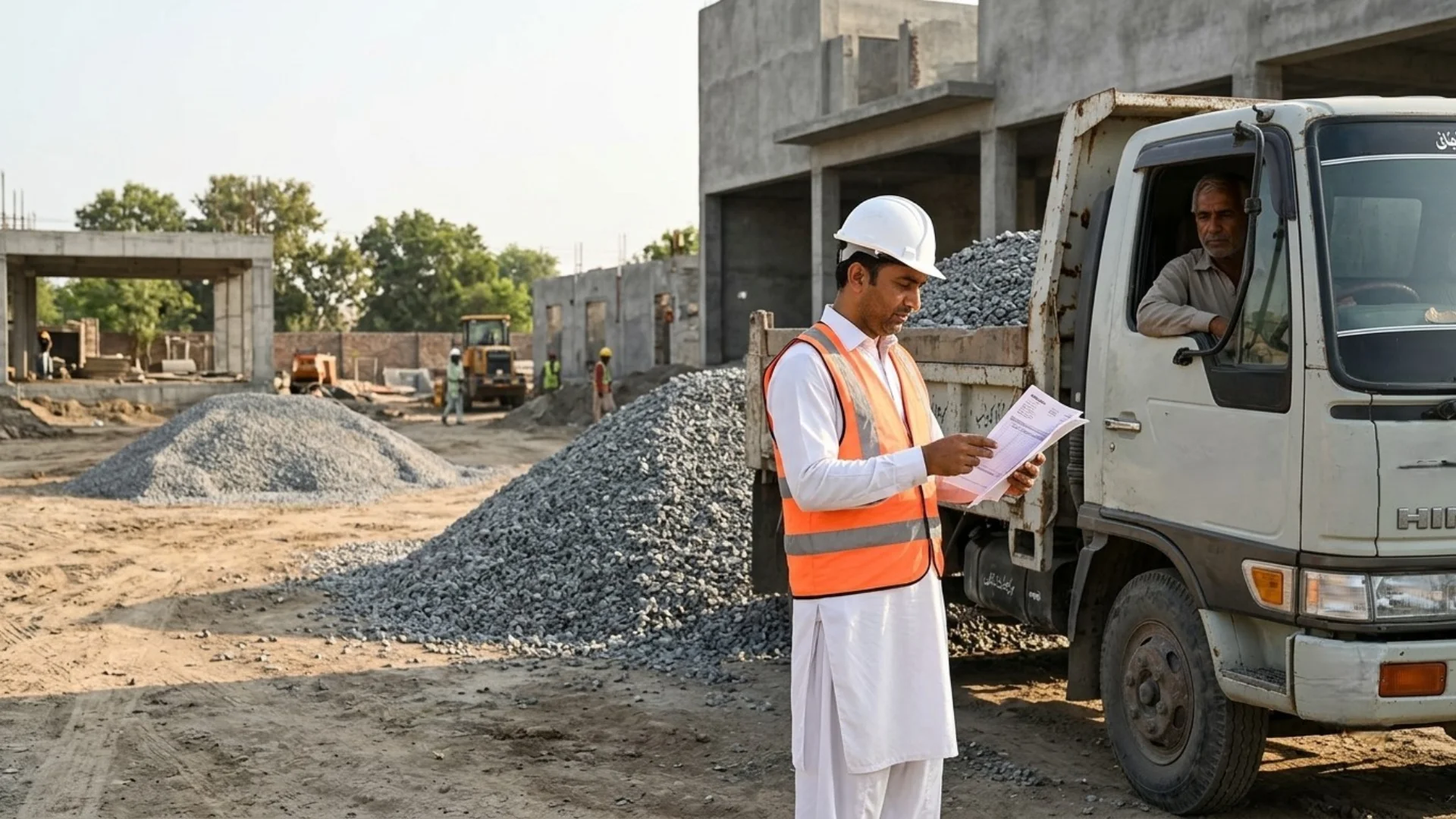
Arrange as per the construction stage, and order as per the pouring load. This will keep your site clean and give you extra cash to spend.
Order the same size and type specified by your engineer, and inspect it before unloading.
A supplier having lower rates but located far from the quarry may actually cost more than a supplier having higher rates but near the quarry.
Related: https://gharhub.com/bajri-buying-scams-price-quality-quantity
Conclusion
The appropriate quantity of bajri depends on your design, not plot size. Covered area will form the base point. No. of floors, foundation, slab & beam sizes, and concrete mix will give you the appropriate value.
Published samples will give you an idea about the scale. Considering the current prices at GharHub, the crush required would be around Rs 288,000 for 5 Marla, Rs 500,000 for 10 Marla, and Rs 656,000 for 1 Kanal before transportation costs. However, your own house may differ from these quite significantly. Therefore, consider values from your structural plans and BOQ. Calculate each component, convert to bajri with the appropriate mix, and make a reasonable allowance.
FAQs
How is bajri calculated for a 5 Marla house in Pakistan?
Start with the covered area from your approved plan and not from a 1,125 square foot plot. Note down all concrete parts from your structure drawings and calculate the volume of each of them. Now, use your engineer's mix to calculate bajri.
How is crush calculated for a roof slab?
Length multiplied by width multiplied by thickness in feet will give the volume of concrete needed. For a nominal 1:2:4 mix, multiply the volume of concrete by 1.54 and then by 4/7. A 20 by 30 foot slab 5 inches thick has 250 cubic feet of concrete and requires approximately 220 cubic feet of bajri.
How do you calculate bajri for a 10 Marla house?
Same approach: covered area, concrete volume per element, and then bajri from the mix. The 10 Marla houses may have longer spans, deeper beams, and thicker slabs.
Does the double-storey house need more bajri than a single-storey house?
Yes. In addition to another roof slab, beams and columns are added. Even the foundation size will become larger to carry that additional load. Thus, on the same plot size, a double-storey house will need much more bajri.
How do you determine poor-quality crush?
A huge amount of dust, clay, or mud is one way. Rub a handful of it in a bucket of water; if the water is extremely muddy, the stone is dirty. Also check for soft stones that break easily by hand, flaky and elongated stones, and highly varied sizes of stones. If it does not match your order, reject the load.
How is the bajri quantity for a 1 Kanal house determined?
The quantity of bajri for a 1 Kanal house should be based on the engineer’s bill of quantities (BOQ). There is no standard rule due to the variation in large houses.
What are the determining factors for crush price in Pakistan?
The determining factors for crush prices in Pakistan include quarry location, stone size, and grade. Transportation distance and route determine freight cost.
How can you measure the quantity of bajri delivered to your site?
Measure the load before it is tipped. Multiply the inside length, width, and height of the load in feet to get the quantity in cubic feet.