 Contact Us
Have you ever opened your electricity bill and wondered, “Why is this so high?”In 2026, the mean electricity tariff in Pakistan can be considered to be around Rs 33.38 per unit power, still, this value is not entirely representative of the situation in the country. Your real bill contains fuel charges, taxes, chargers and may have an additional amount charged to it in case you are not a filer of income tax.
This guide breaks it all down in a simple way so that anyone, even first‑time readers can fully understand how electricity rates and taxes work in Pakistan in 2026.
National Average Electricity Tariff 2026 - What You Need to Know
In January 2026, NEPRA (National Electric Power Regulatory Authority) set the national average uniform electricity tariff at Rs 33.38 per unit. This is comparatively lower to the previous year rate of 34 per unit which brought some relief to the consumers.
This average however does not include other charges like fuel adjustment, taxes or regulatory cost added later in your monthly bill.
Electricity Tariff Slabs for Domestic Consumers (2026)
Pakistan does not have equal electricity rates. They are organized in slabs, i.e. the more you consume, the higher you pay unit by unit:
Consumption Category | Monthly Units | Tariff (Rs/unit) |
Lifeline (lowest users) | Up to 50 | 3.95 |
51 - 100 | 7.74 | |
Protected Domestic | 1 - 100 | 10.54 |
101 - 200 | 13.01 | |
Non-Protected Domestic | 1 - 100 | 22.44 |
101 - 200 | 28.91 | |
Average Residential | 201 - 300 | 33.10 |
301 - 400 | 37.99 | |
401 - 500 | 40.22 | |
501 - 600 | 41.62 | |
601 - 700 | 42.76 | |
Highest Slab | Above 700 | 47.69 |
This means low‑consuming households pay much less per unit, while higher electricity usage pushes the rate up.
What Your Electricity Bill Really Includes
Your monthly electricity bill is composed of multiple components:
Base Tariff – The base rate per unit you saw in the table above.
Fuel Adjustment Charge (FAC) – This fluctuates depending on actual fuel costs each month.
Transmission & Distribution Charges – These include the expense of distributing electricity in generation plants to your house.
Taxes – Your total bill was subject to general sales tax (GST/VAT).
TV Fee and Regulatory Surcharges – Additional government or NEPRA fees.
Non‑Filer Charges – Extra charges if you are not registered for income tax.
Taxes and Extra Charges on Electricity Bills 2026
Electricity bills in 2026 include various taxes and fees. The major ones are:
General Sales Tax (GST)
A percentage tax applied to your total bill amount depending on provincial tax rules.
Regulatory Charges
NEPRA or government mandated charges that support tariff adjustments or regulatory frameworks.
TV Fee
Some electricity bills include a small TV or media levy charged by the government.
Non‑Filer Domestic Income Charges
If you are not listed as a filer with the Federal Board of Revenue, your bill might include an extra surcharge as a non‑filer penalty.
Who Gets Special Rates and Who Pays More?
Some users in Pakistan may be eligible for special electricity rates or exemptions, including:
Lifeline Users - Lower per unit tariff for minimal usage.
Agricultural Connections - Often discounted under government policy.
Government or Public Service Offices - Give different pay according to agreements.
Exemptions for Certain Users - Incentives are given in certain cases in the industrial or charity sectors.
Make sure that you look at the most recent NEPRA notice or the public notice of your electric supplier to determine whether you have a new exemption.
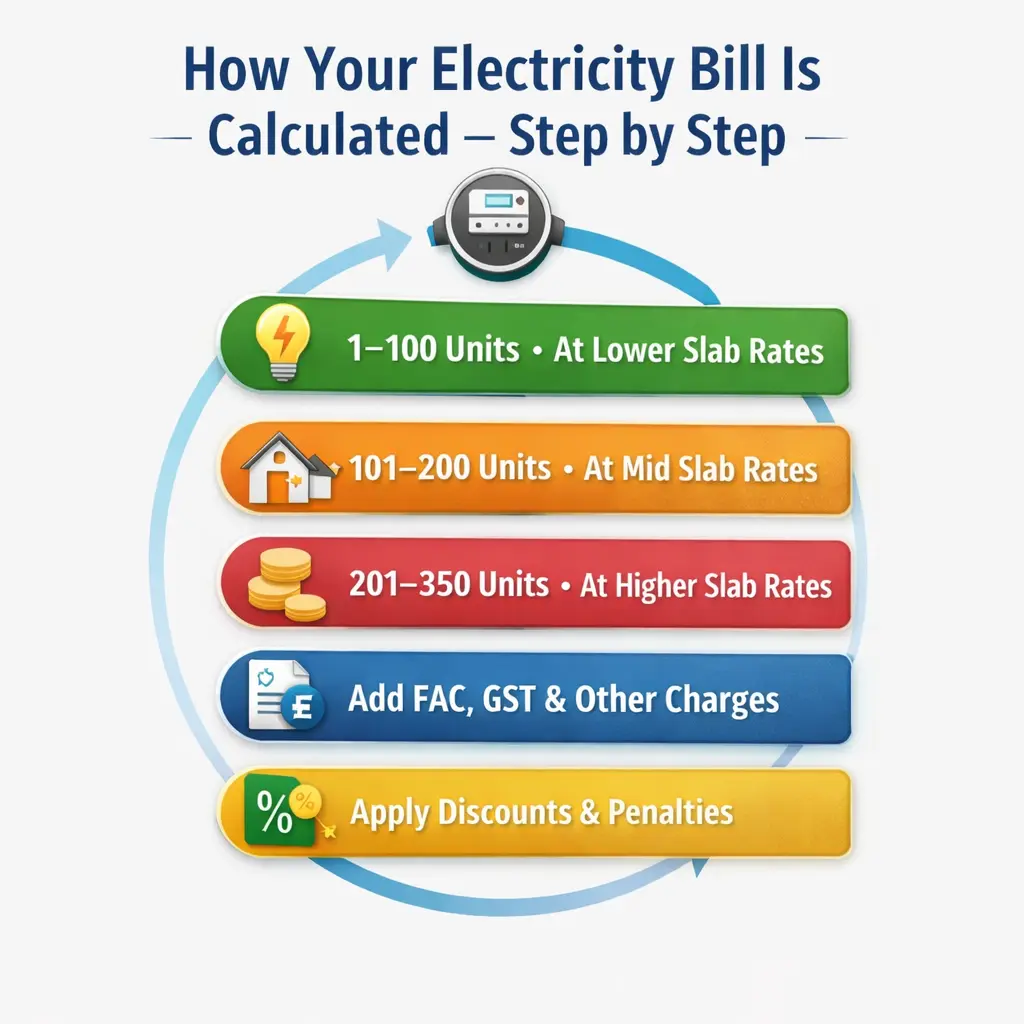
How Your Electricity Bill Is Calculated - Step by Step
Let’s say your household uses 350 units in a month. Here’s a simplified calculation:
Units 1–100 at lower slab rates
Units 101–200 at mid slab rates
Remaining units (201–350) at higher slab rates
Add FAC, GST, and other charges
Apply any discounts or penalties
Recent Policy Updates Affecting 2026 Electricity Bills
Quarterly Tariff Adjustments
In early 2026, NEPRA approved a quarterly tariff adjustment, adding about Rs 0.35 per unit to bills from March to May 2026.
Industry and IMF Discussions
The IMF is on the verge of negotiating with the Pakistani government on the probable adjustments in the tariffs to balance economic stability without overworking the middle and low-income families.
These updates mean your electricity bill may change periodically, not just once a year.
Tips to Reduce Your Electricity Bill in 2026
Here are practical, easy strategies:
Use energy‑efficient appliances (LED lights, energy‑star rated devices).
Avoid peak usage times - spread out high‑power appliances.
Consider net‑billing or solar energy solutions (but check the current regulations).
Check your filer status - being a registered filer can reduce surcharges.
Conclusion
The unit rates, fuel charges, taxes, and regulatory decisions affect the electricity bills in Pakistan in the year 2026. When you understand how your bill is computed, where you are being overcharged, and how you can use less of the product, then you are able to control your cost better.
CTA BUTTON: Follow GharHub for more further updates
FAQ’s
Q1: What is the per unit cost of electricity in Pakistan in 2026?
The national average electricity tariff is set at Rs 33.38 per unit.
Q2: Are there extra taxes on electricity bills?
Yes, taxes, TV fees, and surcharge for non‑filers may be added.
Q3: Who qualifies for lifeline rates?
Households consuming up to 50 units per month benefit from the lowest tariff.
Q4: Can my bill change during the year?
Yes, quarterly adjustments and policy changes may affect charges.