 Contact Us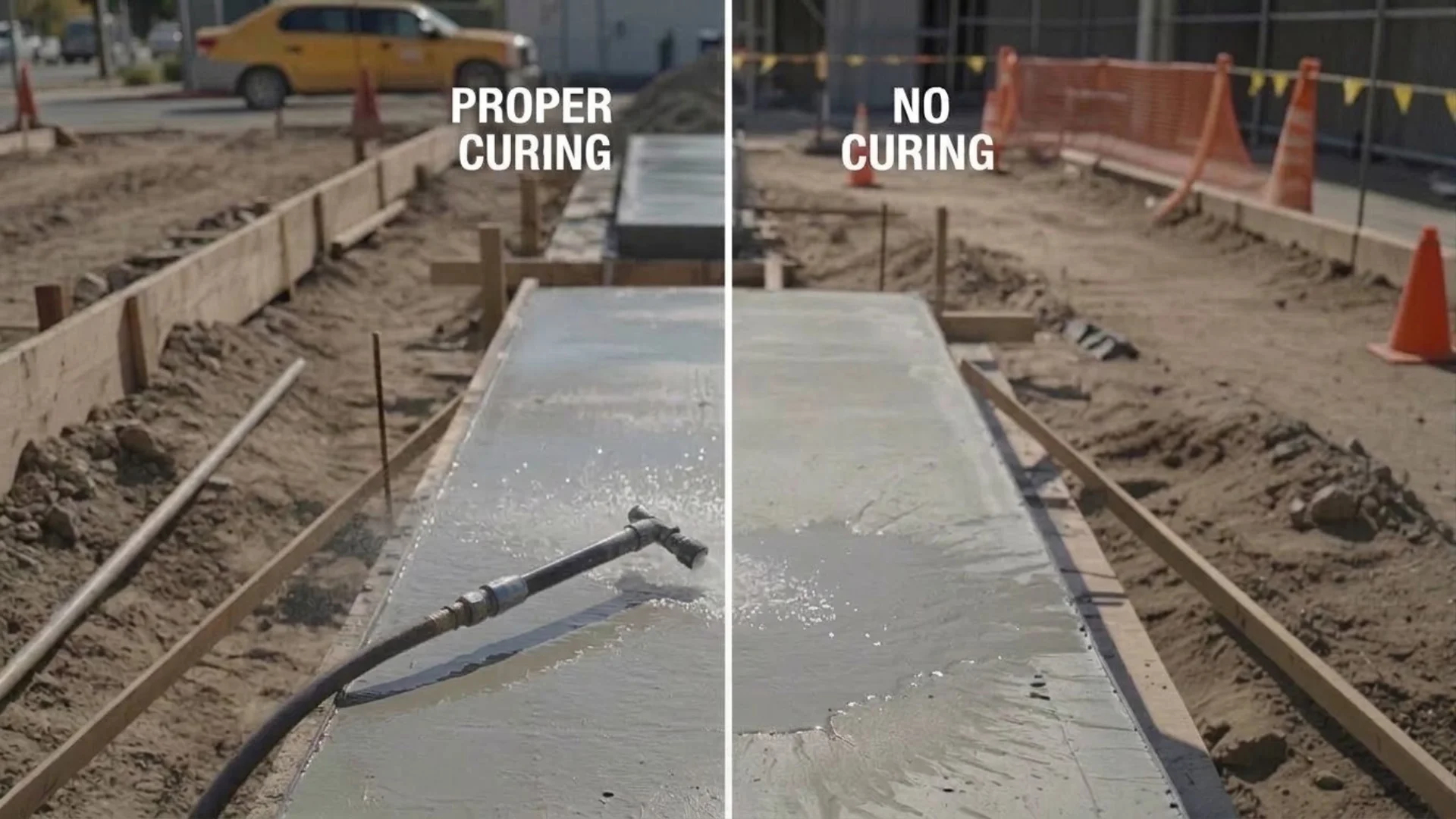
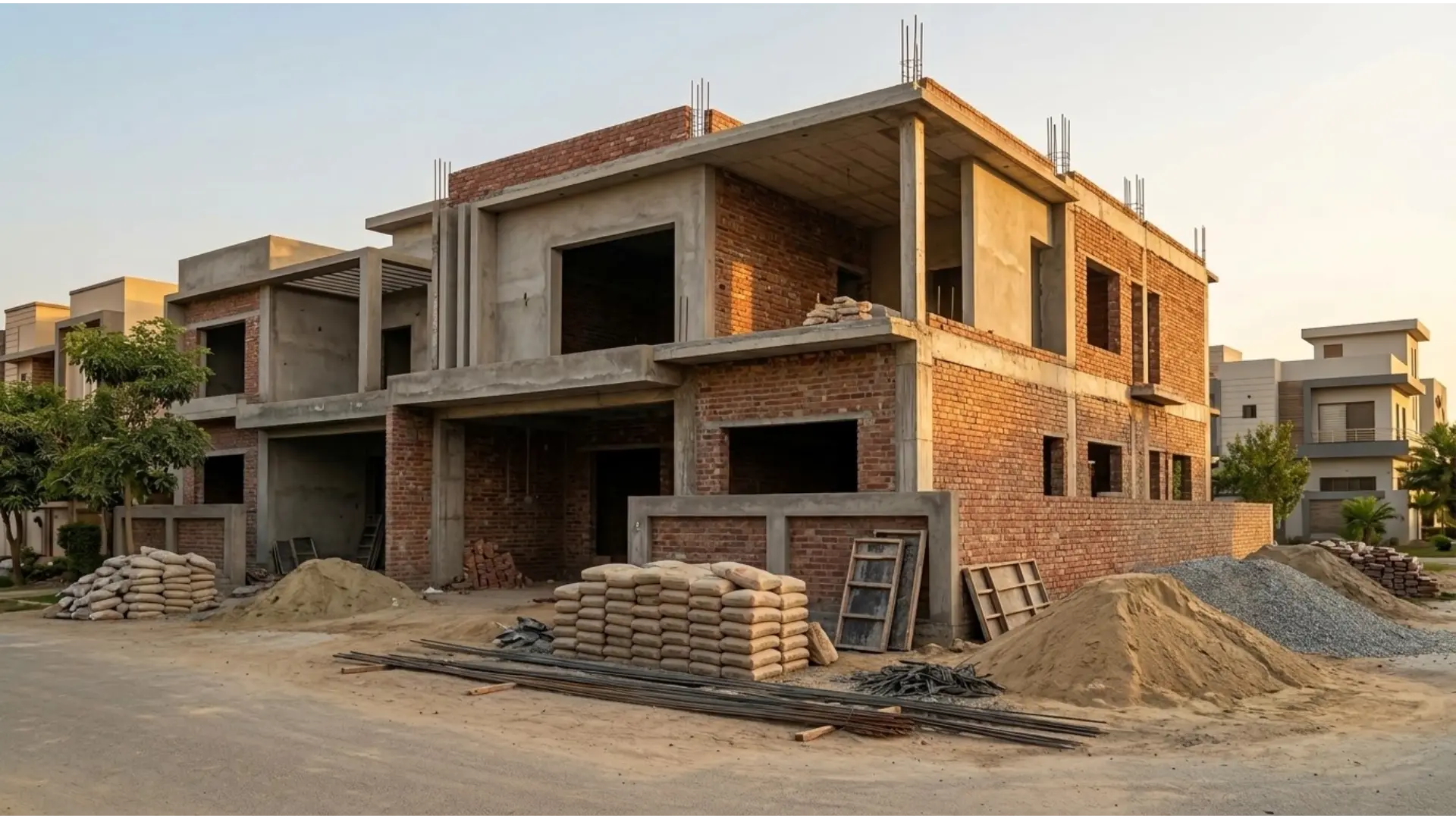
Concrete is used in most major construction works in Pakistan, ranging from residential homes to commercial buildings, as well as roads and infrastructure. The appearance of concrete after placement might seem tough and resilient. However, the first days after concrete placement are crucial. Excessive loss of moisture and unsuitable temperatures will result in poor development of concrete strength and durability.
The consumption of domestically produced cement in Pakistan during the period of July to March FY2026 was 31.6 million tonnes, an increment of 10.5% in comparison with the similar period of the previous year. This increased usage of cement emphasizes the necessity of proper concrete practices, not only high-quality cement.
Proper curing of concrete is among the most essential stages in the work with concrete. Curing helps in maintaining the required moisture and temperatures for cement hydration and development of strength and durability of concrete. Poor curing results in cracks on the concrete surface.
What is Curing?
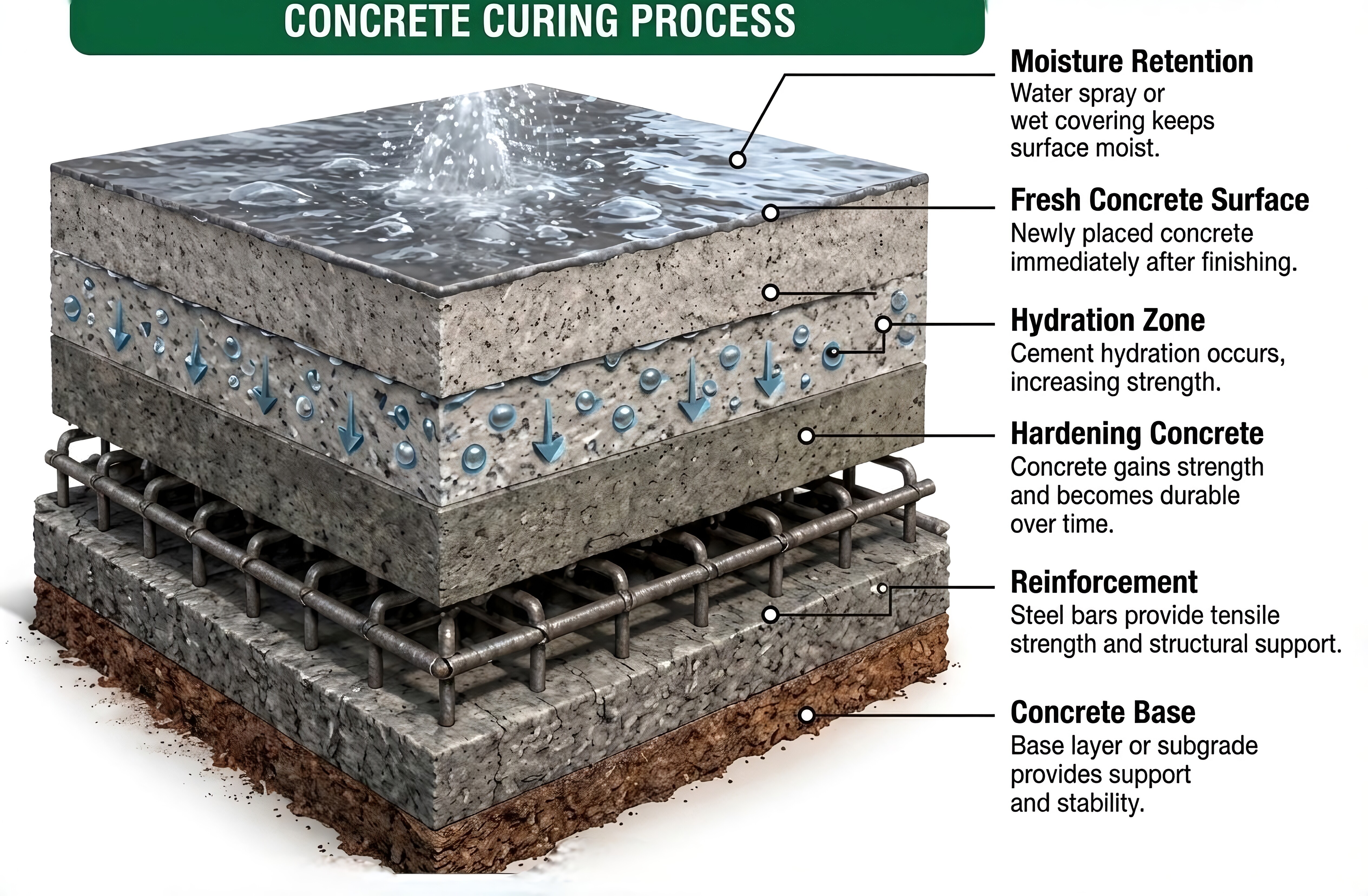
The curing process is a procedure of managing moisture and temperature levels after the placement of concrete. It provides adequate moisture and time for Cement to keep undergoing the hydration reaction and gaining strength.
Hydration is a chemical reaction between water and cement. Hydration produces materials that act as binding materials for concrete. The calcium silicate hydrate, or C-S-H, is one of the hydration products and an important source of concrete strength and durability.
Curing is not about water addition to concrete. Curing is about providing proper conditions for hydration to proceed smoothly.
Bad curing can impact both the surface and performance of the concrete. When there is a quick loss of moisture from concrete, hydration might be affected, hence weakening its strength and causing cracks due to shrinkage.
Problems associated with bad curing are:
Surface cracking
Weakness in concrete strength
Poor surface hardness
High permeability
Low durability
Shrinkage
Poor resistance to abrasion
Inconsistent moisture and temperature conditions
Before curing, check:
Factor | What to monitor |
Temperature | Concrete and surrounding temperature |
Moisture | Surface should not dry too quickly |
Wind | High wind can increase evaporation |
Humidity | Low humidity can increase moisture loss |
Sunlight | Direct sun can increase surface heating |
Curing method | Use a method suitable for the project |
Concrete Curing Compounds
Curing compounds are liquid materials applied to the concrete surface. They form a film that helps reduce the loss of water from fresh concrete. They are useful when traditional water curing is difficult or impractical.
For example, curing compounds can be used on:
Large slabs
Roads
Pavements
Industrial floors
Large concrete surfaces
The correct product and application method should follow the project specification and manufacturer instructions.
The Importance of Timing in Curing
Timing is very important because the concrete can dry out very fast.
The timing of curing will depend on when it is time to cure the concrete using the method chosen. Delaying the process can result in excess drying before starting to cure. The weather conditions are different and vary the risk.
Hot, humid, windy, and sunny weather will increase evaporation, while cold weather can slow down the process.
What Are the Different Methods and Uses of Concrete Curing?
The right method depends on the type of concrete, weather, surface area, project requirements, and available resources.
1. Water Curing
Water curing keeps the concrete surface continuously moist. The water should be applied carefully. A sudden temperature difference between the concrete and curing water can create thermal stress.
Common techniques include:
Ponding
Immersion
Wet coverings
Spraying
Continuous water application
2. Sprinkler or Wetting Curing
Sprinkling or spraying water over the concrete surface helps maintain moisture. It can work well for larger exposed areas.
3. Membrane Curing
Membrane curing creates a barrier over the concrete surface. The barrier reduces moisture loss and allows hydration to continue.
Common materials include:
Plastic sheets
Liquid membrane-forming compounds
Membrane methods can be useful where continuous water curing is difficult.
Related: https://gharhub.com/shop/insulation-membrane
4. Curing Compounds
Curing compounds are sprayed or applied over the concrete surface to reduce water loss. They can be useful for roads, pavements, floors, and other large surfaces.
However, compatibility matters. Some curing compounds may affect later coatings, toppings, or bonding operations.
5. Fogging or Spraying
Fogging creates a fine mist over the concrete. It helps increase the moisture around the surface and reduce rapid evaporation. This method can be particularly useful when weather conditions create a high risk of surface moisture loss.
Best Practices for Concrete Curing
Proper curing is not only about choosing a method. It is also about using that method correctly.
Temperature Control
Temperature affects the rate of cement hydration. Higher temperatures can speed up hydration, while low temperatures can slow it down. But very high early curing temperatures can also affect long-term strength development.
Duration of Curing
Do not assume that every concrete surface needs the same curing period. The required period depends on factors such as:
Cement type
Concrete mix
Strength requirements
Temperature
Moisture conditions
Use of supplementary cementitious materials
Project specifications
Curing Challenges
Construction sites can face several curing problems. Planning can reduce these risks.
Challenge | Possible effect |
Hot weather | Faster moisture loss |
Strong wind | Increased evaporation |
Low humidity | Faster surface drying |
Cold weather | Slower hydration |
Direct sunlight | Increased surface temperature |
Poor water supply | Inconsistent wet curing |
Wrong curing method | Reduced effectiveness |
Quality Control and Monitoring
Curing should be checked rather than assumed. Site teams can monitor for important projects; strength testing and other quality control procedures can help confirm whether the concrete is developing as required.
Curing Beyond Initial Stages
Concrete continues to develop properties after its first few days. That does not mean the surface must always remain wet forever. It means early curing conditions can influence later performance.
Good curing therefore forms part of a larger quality process that includes proper mix design, placement, finishing, curing, testing, and maintenance.
Why Is Curing So Important in Construction?
Curing is important because it helps concrete develop the strength, durability, and surface properties needed for its intended use.
The main benefits include:
1. Helps Concrete Gain Strength
2. Reduces Cracking Risk
3. Improves Durability
4. Improves Surface Hardness
5. Supports Long-Term Performance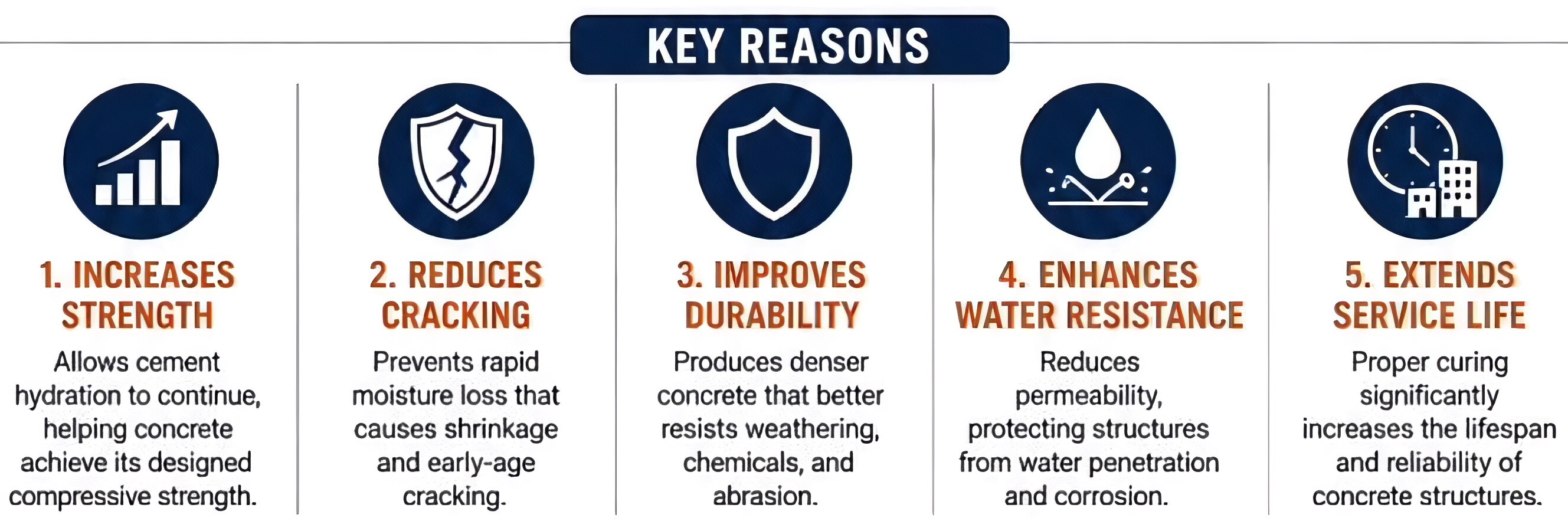
Post-Curing Maintenance
Though curing eventually comes to an end, concrete should still be properly maintained. After curing is complete, it is important to refrain from damaging the concrete surface.
There are certain maintenance activities that one may carry out to ensure that concrete is in good condition, such as:
Inspection of concrete surfaces.
Crack repairs where necessary.
Maintaining efficient drainage systems.
Minimizing exposure to chemicals.
Protection from excessive abrasion of the surfaces.
Observance of the recommended loading period.
Inspection of wet or severely weathered surfaces.
Related: https://gharhub.com/mistakes-during-grey-structure-construction
Conclusion
Curing concrete is a straightforward concept, yet with a significant effect on the quality of construction.
It provides the cement with adequate conditions for hydration. Correct curing could help achieve higher strength, reduce the chance of cracks due to moisture, increase the surface hardness, and enhance the durability of the material.
The choice of curing technique depends on many factors such as the mixture of concrete, the nature of the construction project, the weather, the surface, etc. Proper curing helps achieve desired qualities of concrete.
Frequently Asked Questions
How long should concrete be cured?
The required time depends on the cementitious materials, mix design, temperature, moisture conditions, strength requirements, and project specifications.
Why is water important for concrete curing?
Water supports cement hydration. If concrete loses too much moisture, hydration and strength development can be affected.
What happens if concrete is not cured?
Poor curing can lead to lower strength, increased surface cracking, greater shrinkage, weaker surface properties, and reduced durability.
What is the best method of curing concrete?
Water curing, wet coverings, membrane curing, curing compounds, plastic sheets, and fogging can all be suitable in different conditions.
Does temperature affect concrete curing?
Yes. Temperature affects the rate of cement hydration and strength development.
Can curing prevent all concrete cracks?
No. Proper curing can reduce the risk of moisture-related shrinkage cracking, but cracking can have many causes.
Is curing necessary for every concrete structure?
Curing is an important part of most concrete construction. The exact curing requirements depend on the project, concrete mix, environmental conditions, and applicable specifications.